

AI has changed PMF forever
Product-market fit is no longer a destination. It's a state. What should founders do about it?

👋 to the 2 new founders who subscribed in the past week. Forwarded this? Subscribe and join 347 founders getting their weekly dose of Founder Therapy.
One quick note before we start, I’ve been working on a podcast with Somrat Niyogi called The First Pitch: we talk to venture-backed founders about the original pitch that secured them funding and the journey since. Trailer below, first episode on June 10th on YouTube and Spotify.
Enough notes - let’s dive in!
Two weeks ago, I was on a panel about finding product-market fit (PMF) in the AI era.
One of the speakers was Loren Alhadeff, former CRO and COO at DocuSign and current Venture Partner at Madrona. He said something I’ve been thinking about a lot since.
When he described PMF at DocuSign, he described it as a stage, a moment you arrived at. You deployed the product. If you found product-market fit, it was soon integrated into enterprise infrastructure and embedded everywhere.
Essentially, once you ‘had it,’ you were in.
Then he talked about PMF today, and it’s 100% aligned with what I see at Clarify and hear from fellow founders:
“It [PMF] doesn’t feel like a stage anymore. It feels like a state. There’s no such thing as ‘we now have it, so we’re good.’”
For me, hearing this was a timely reminder. As much as I know that PMF is now an ever-moving target that I have to stay ahead of, I still fall back into the old way of thinking about PMF as something you achieve once and revisit never.
And to be completely honest, sometimes I think about the old way and miss how simple it was.
You’d find PMF, you’d exhale, and you’d focus on scaling.
Today, you can’t afford to exhale. If you do, you lose PMF. That’s how quickly things are changing with AI.
PMF is no longer a final destination
I’m being reminded of this myself every day. It’s hard. As someone who founded a company before the AI era and another one during the AI era, I have to remind myself to stay in discovery mode all the time.
For example, I recently went through Clarify’s customer onboarding flow for the first time in six months. I went in thinking it was going to be nearly flawless and intuitive. Yet I found our activation funnel was broken in ways I never expected. Many things I thought were intuitive for customers were anything but.
That’s what happens when you treat PMF like a final destination, when in reality (and especially today), it’s more like a never-ending journey.
Reforge also reinforces this with the idea of the PMF Treadmill: Product Market Fit is a key milestone to reach, but it’s often misinterpreted as being a static moment in time. The reality is that your customer base is always changing and consumer expectations are always growing. Once you get initial product market fit, you not only have to keep it but also expand it.
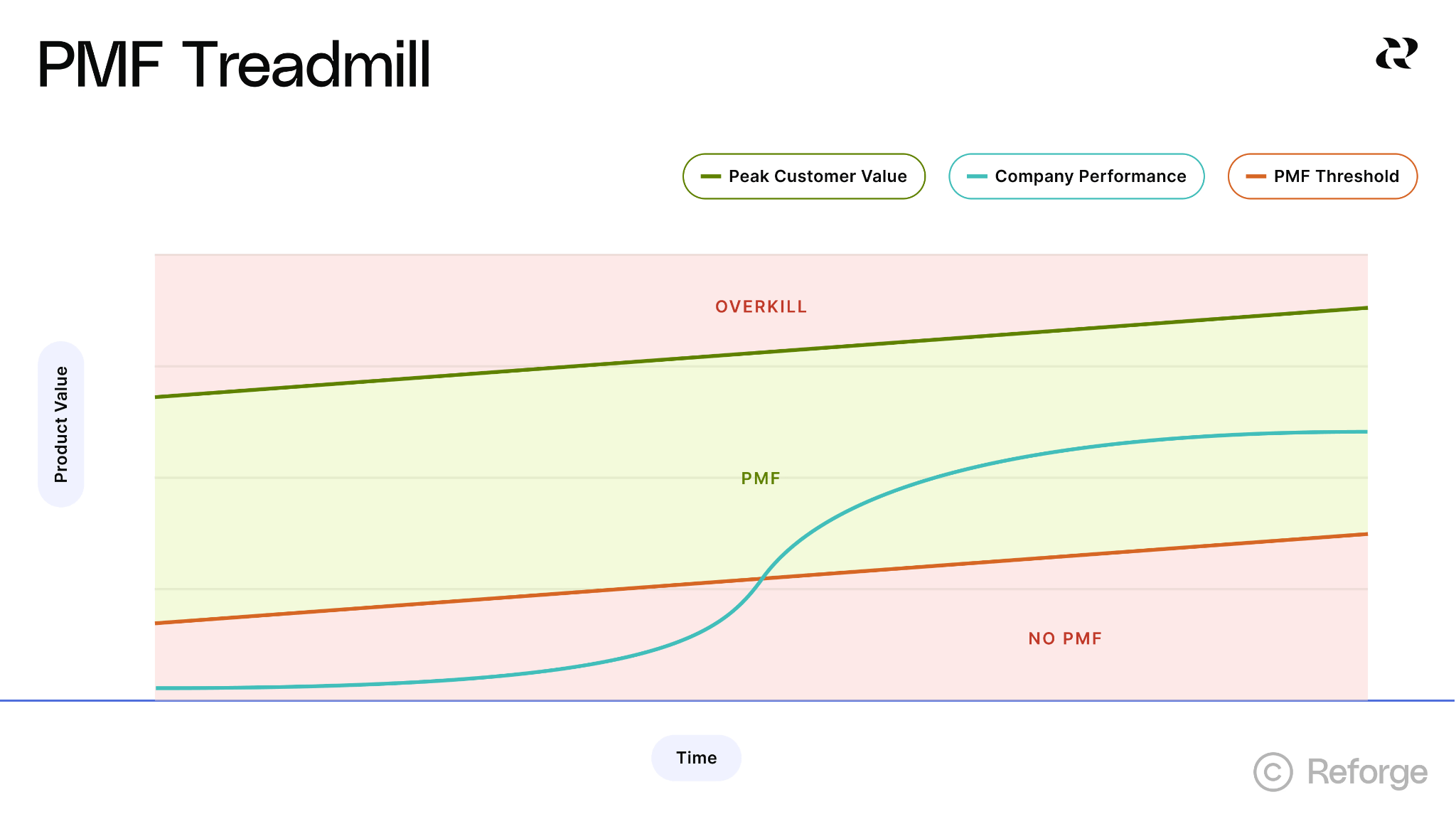
AI is a large reason for this, which is great in some ways and challenging in others.
Nowadays, we can all build faster, ship more, and reach more people sooner. That’s great if you have PMF. It’s really bad if you don’t. Going a million miles an hour in the wrong direction is the fastest way to an ugly exit.
But if you have PMF, then AI makes rapid, exponential growth more possible. I like the way Collin Stewart, co-founder of Predictable Revenue, talked about this relationship between PMF and GTM:
“Product-market fit, that strength is a big multiplier of your go-to-market engine. The stronger your product-market fit is, the more you’re gonna get out of that engine.”
What maintaining PMF in 2026 actually looks like
For me it comes down to one thing: talking to customers. I’m still doing 10 to 12 customer calls a week.
Not because I love it more than building. But because the moment I stop talking to customers, I begin navigating by memory instead of feedback. And memory is a magician…it can play tricks on you and warp reality.
There’s also a difference between talking to customers and talking to the right customers.
I tend to weight about 80% of my calls toward prospects, 20% toward existing accounts. This mix helps me stay close to different needs of our target customers, including those already familiar with us and our product and those in the consideration phase. It’s the best way to pick up on any opportunities (or red flags) around our PMF.
What I’m looking for in those calls is an existential need for our product. So, I’m constantly thinking: If our product went away tomorrow, what happens to our customers’ businesses? If nothing changes, or if they can replace us with something else rather easily, then do we really have PMF?
Like Loren said during the panel, “If the reaction is, ‘Oh well, there’s like six other things that I kinda know about that I think sort of do some of the similar things, and it’s actually pretty easy to just swap over,’ that’s not [product-market] fit.”
Taste is still the difference-maker between ‘initial traction’ and PMF
It seems like everyone’s talking about it right now, but taste is another critical thing to keep in mind when thinking about PMF.
It’s easy to build something right now. Vibe code a product in a weekend, get it in front of people, see if it has traction. That’s a legitimate capability today. But just because something is easy to build doesn’t mean it’s easy to build well. You’re probably vibe coding something that’s a C product. You might get initial traction. But so many people doing this are mistaking that little bit of traction as product-market fit.
Before they find out they don’t have it, it’s too late.
Truth is, an A+ product still requires taste. You need to be a founder with conviction and human judgment about what matters and, just as importantly, what doesn’t matter. It also takes close proximity to a lot of customers to learn the difference between someone who’s excited and someone who would actually panic if your product went away.
There may be more software products than ever right now. That doesn’t mean they’re good. Most of them are C products, very few are A+ with true, ongoing PMF. Don’t trick yourself into thinking that the difference is speed. Everyone is fast now. The biggest difference-maker today is taste, hands down.
The innovator’s dilemma, reframed
Loren called maintaining PMF an innovator’s dilemma. You’re constantly iterating to keep users ingrained with the product. The moment you stop, someone else starts.
I think about it like fitness. Nobody finishes a marathon and stops training forever. The finish line is just a marker. The state is ongoing.
Stay close to the customer. Keep asking the hard questions. And whatever you do, don’t exhale.
Until next week,
Patrick
Additional Reads:
Why $100M Doesn’t Mean You Have Product Market Fit - Elena Verna via Growth Talent