

Finding the balance between remote, hybrid, and in-person
Hiring great people is step one. Helping them work well together is the job.

Hey everyone - hope the Americans here had a great Thanksgiving weekend.
I’ve been thinking a lot about remote vs. hybrid vs. in-person work lately as we scale the Clarify team.
This topic has been debated to death, but I’m realizing there’s a gap between the broad “what works best” conversations and what actually matters for early-stage companies: a dialogue while we’re figuring it out.
We opened a small Seattle office this fall, and it pushed me to look hard at how our culture actually works with some folks in the office, some remote in the US, and others dialing in from London, Paris, Sydney, and Lisbon.

Culture shows up in the normal parts of the week, from busy Mondays to quiet Thursdays. It’s how we decide what to build, who talks to customers and owns the outcome, and what we choose to celebrate after a release.
Remote doesn’t change that.
It just means we have to be clearer about how we work and what “good” looks like when we are not in the same room.
Where we misjudged early
We wrote our values before we had a real team. As we hired, I didn’t go back and check whether those words still matched the people we brought in.
If I were doing it again, I would revisit them at ten people, and then again when we crossed into the low twenties.
We also said we wanted a balance between Seattle and remote. Then we hired the best people wherever we found them, and most of them weren’t in Seattle.
I don’t regret those hires (I absolutely love our team), but I should’ve been clearer about how that mix would work in practice.
Where location fits in
About 20 percent of our team is in Seattle. The rest are spread across time zones.
I’m still back and forth about what has been the best approach for us.
Remote first and in-office is clear. Hybrid has been the hardest one to crack.
We have two company offsites a year and try to keep a light meeting load. On their own, these rituals did not create the shared rhythm I hoped for.
The Seattle office is for folks to build a rhythm in person, especially for onboarding and in the run-up to big launches.
We’ll keep hiring remotely, but we’re more deliberate about creating local groups that can meet in person on a schedule that fits the work.
And I still think it’s worth bringing the full company together twice a year. Those moments are still valuable to us.
How we work today
Even though there are now folks in an office together, we still try to operate as if we’re fully remote.
I liked this perspective from Randy on one of my LinkedIn posts:
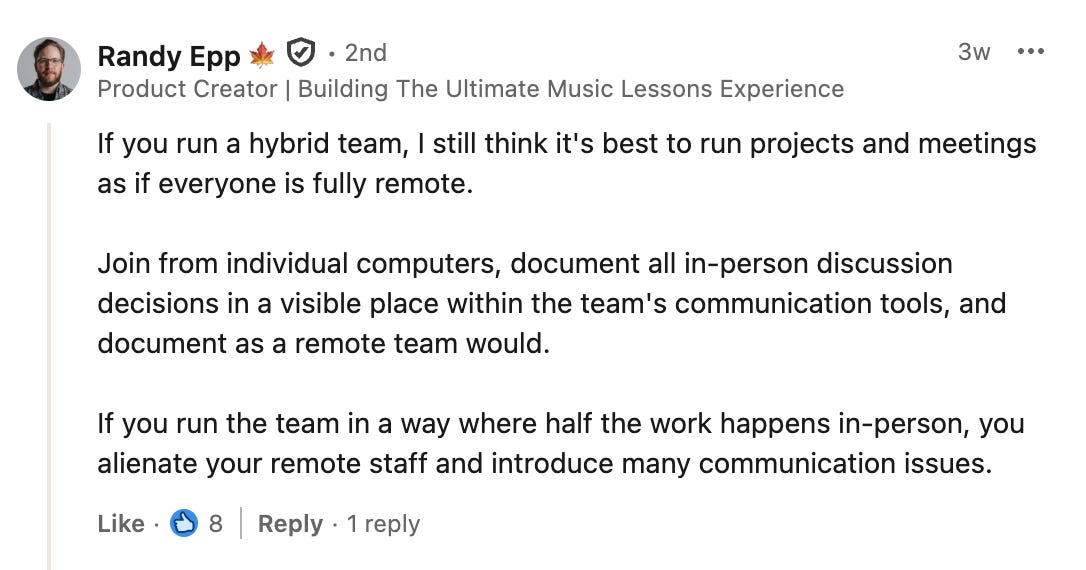
No one should get more context or influence because they’re in an office. If a conversation starts in the office, it moves to a shared doc or Slack, so the whole team can see it.
We plan around time zones to make sure our entire global team feels prioritized. We get about 2–3 hours of overlap for live work, which we use to our advantage.
The rest happens in docs, Slack, or recordings (like video meetings or Looms)..
Those company gatherings we have twice a year are purposeful, and we tie each trip to a clear agenda and outcomes.
What I am still learning
I’m not done figuring this out. These are the three points I’m focused on right now:
Values need to match the team you actually have (and it needs to translate beyond just in-office), not the one you imagined on day one.
Hybrid only works if you hire toward it and give people clear ways to work together.
A healthy hybrid culture treats remote and office equally. We keep decisions in an open environment, so perks and context don’t depend on where you sit.
As you can tell, I don’t have this completely solved (does anyone?). I’m still learning and trying to be honest about what’s working here and what’s not.
I’d love to hear your perspective on this and if any of the above specifically resonated with you.
—Patrick
Additional reads
Are we returning to the office? Or is the future remote? - A piece from a16z from 2021 with timeless questions, lessons, and data.
The billion-dollar AI startup rejecting 996 hustle culture - An article about culture with thoughts from Karri (CEO of Linear), a company we deeply admire.