

Time management as a founder is an oxymoron
My days don't match, delegation breaks my brain, and tools only help so much.

This week at Clarify, we launched Rep - an incredibly helpful personal sales agent. We built it to take the admin time out of founder-led sales. I use it daily, because I need to.
This got me thinking more deeply about time management as a founder, which can be a bit of an oxymoron. In this post, I’ll examine how I actually spend my time, what systems work, and where tools help.
I’m not trying to write a playbook here. I’m sharing what my days look like, why they feel messy, and a few things I lean on to keep moving.
My days don’t match, and that’s fine
Most weeks, Monday looks nothing like Thursday. One day I’m deep in recruiting, building a candidate pipeline, interviewing, debriefing with the team. Just trying to land the people we need.
Another day I’m on sales calls, working a POC or an RFP with a customer. I’ll jump into product discussions with engineering when we’re close to a launch to make sure the team has the right context.
Then there’s investor updates, board meetings, strategy work, and then the systems side of running the company so we operate like a real team and not a group chat.
It’s all important. The real challenge isn’t the variety of work, though. It’s choosing what I need to show up for that day.
Prioritization is the job
There are a thousand things I could do in a day. I probably have time for ten.
So I’m always asking myself: which ten things create the most leverage, and what can I hand off?
I’m still bad at this. If I know I can do a task, I’ll just go do it, which feels great for an hour and then adds up to me carrying too much over a month.
I’m working on it. In theory, I like the Eisenhower Matrix to help organize time more effectively:
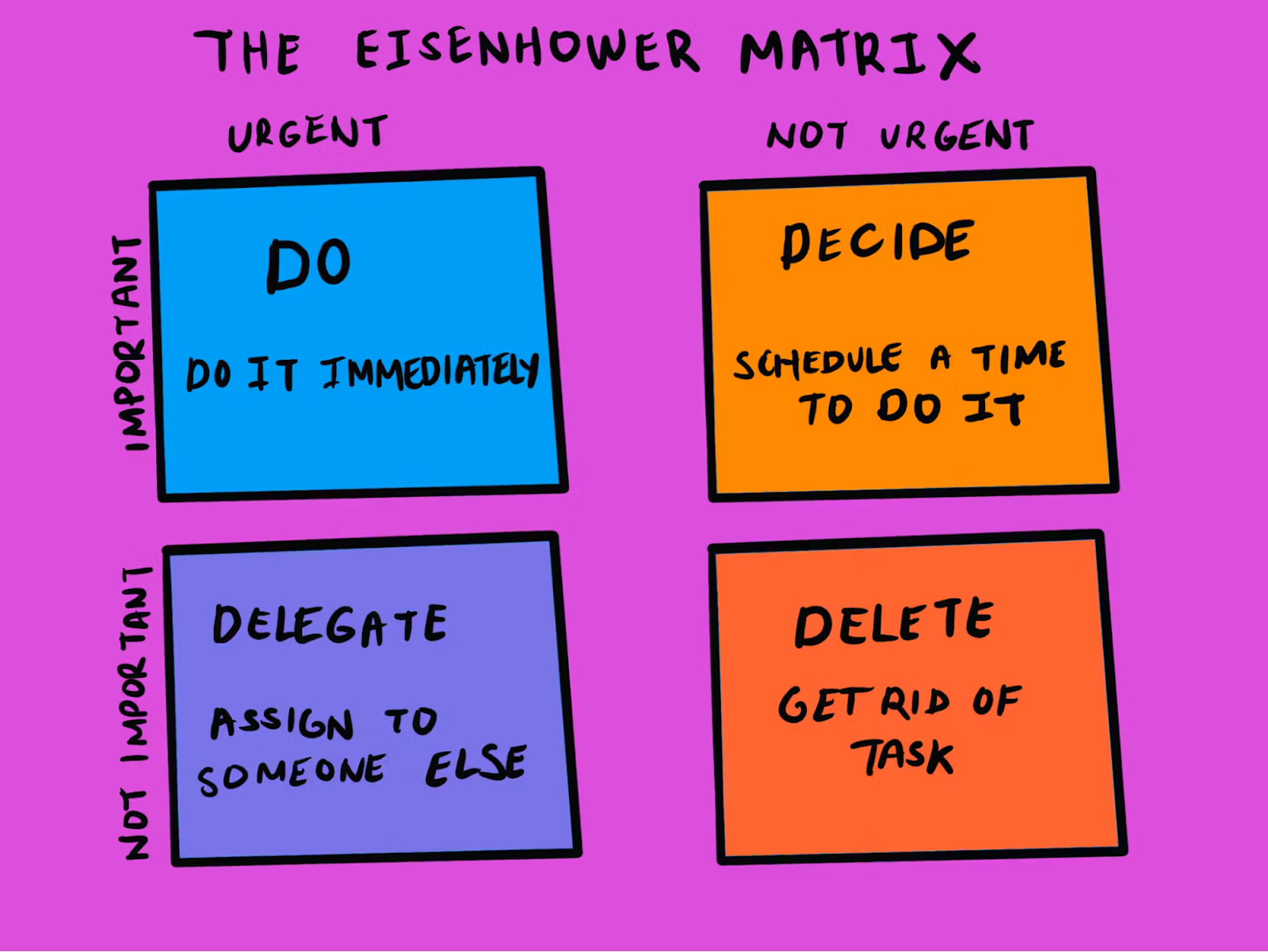
But again, there are so many context switches in a day that it’s not always easy to break the list up into these four quadrants.
Delegation, specifically, is something that I’m always working on improving. Both from the perspective of letting myself delegate, but also delegating in a productive way for both me and the team.
How I delegate without lowering the bar
My pattern is do, show, teach.
I’ll do the thing once the way I want it, share the example, and then talk through why it’s shaped that way. Showing beats telling. If I only describe it, people keep a little. If I walk through a real example, it sticks.
This isn’t only because some folks are visual learners, it’s because something I create can be referenced again. Something I say gets lost in the ether if it’s not recorded
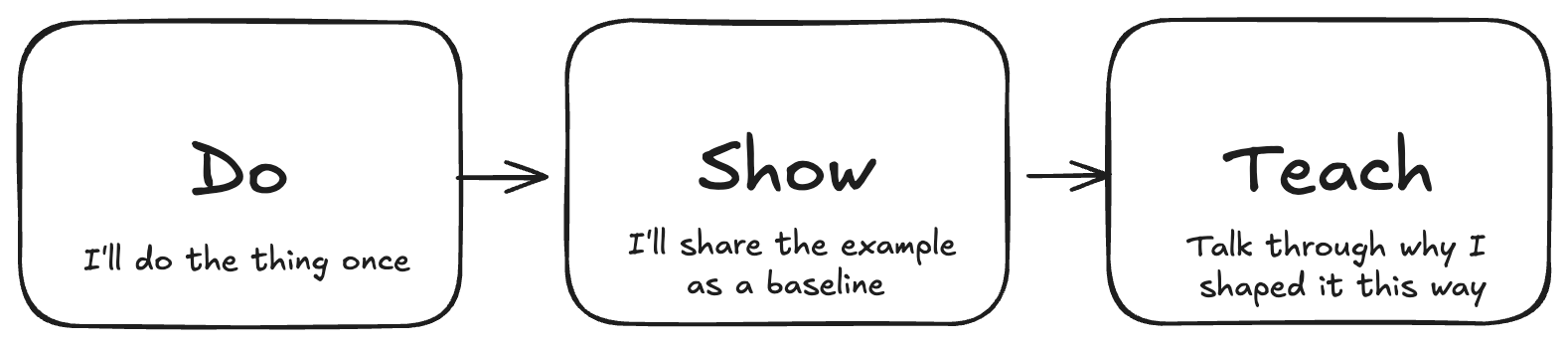
A recent example: I built a POC doc for a potential customer. I outlined use cases, timeline, owners, required info. Now the GTM team can use it as a baseline for future pilots, and improve it. I don’t have to rebuild that from scratch next time.
This becomes much more important as we continue to scale.
Player to coach, on purpose
When we were twelve people, I could stay a player most of the day. Jumping in on an email. Taking a sales call. Leaving feedback on a product spec.
But now, we’re growing past 25 people. I need to scale my time across more of the company. That only works if I spend less time fixing small things and more time helping people win without me jumping in.
In other words, I have to coach more and hire leverage: People who can own whole areas so I’m not the glue or the bottleneck.
Working at three altitudes
I think about my job as shifting between 50,000 feet, 10,000 feet, and 10 feet.
At 50,000 feet: Are we headed the right way?
At 10,000 feet: Are teams aligned and executing?
And at 10 feet: When something is stuck, can I go deep for an hour and unblock it?
The hard part isn’t any one altitude, it’s switching between them all day without losing the thread, or deciding which altitude I need to spend the most time at.
Tools that actually save me time
Ideally, I wouldn’t spend much time at 10 feet at this point. The good news: AI is helping automate a lot of that.
Here are some tools I use daily to get this type of work done efficiently:
ChatGPT is my quick sparring partner. If I’m by myself, I’ll talk through things in voice mode. I’ll switch to Claude when I need better connectors into Clarify or want to stitch across records.
Clarify (duh) is where I prep for and analyze meetings. Before a first call, I’ll have it pull context and draft questions. Before a follow-up, I can jump into the last recording and get up to speed fast. I also use it to look across closed lost notes and shape plans, like sketching a 2026 view from real feedback.
Notion is where all of our docs live today. Their AI search is incredible.
v0 is my go-to for quick UI prototypes. Cursor helps me write product briefs and get a first pass on complexity. It’s useful to ask, “What would it take to build X?,” get a rough plan, and then bring that into a conversation with engineering.
The annoying bit is none of these tools talk to each other super well. No single agent that just moves across everything.
This week as a reminder
This week’s launch was a reminder that tools (including the ones we build) are just part of how I stay above water. Rep helps me prep faster and keep context straight, which buys me back a few hours I’d otherwise lose to admin work.
But the real leverage still comes from the basics: hiring well, coaching well, and choosing the handful of things each day that deserve my full attention.
That’s the discipline I’m trying to get better at. Not optimizing every minute, but making sure the right minutes get my energy.
– Patrick
Additional reads
How I spent 17,784 hours in 5 years as a startup founder - Sam Corcos via First Round. Literally plotted and categorized his time as a founder over 5 years. Fascinating.
How to take the reins of your schedule like a CEO - David Finkel via Inc. acknowledges some simple but powerful truths about time management.
The three altitudes framework nails something most time management advice misses completely. At early stage switching between 50k feet and 10 feet isn't a bug it's the job, but nobody warns you how draining those constant altitude changes actually are. I've found the do-show-teach delegation pattern works well tho the tricky part is resisting the urge to jump back in when someone's first attempt doesn't match the original.